


First seen in the ’80s and then more recently thanks to Bluey, our Duck Cake has been a favourite for generations. Now you can try your hand at the famous Women’s Weekly Duck Cake yourself. Will yours be as good as Bandit’s or will it be better? Either way the kids are sure to be delighted to get their very own Duck Cake for their birthday.
If want a few other birthday cakes up your sleeve, check out some of our other favourites from the Australian Women’s Weekly Children’s Birthday Cake cookbook, where the Duck Cake made its first appearance in 1980!
Ingredients
Method
Make cakes according to directions on packet, pour one quarter of mixture into greased 25cm x 8cm (10in x 3in) bar tin, pour remaining mixture into greased deep 20cm (8in) square cake tin, bake in moderate oven 30 minutes for bar cake, 1 hour for square cake or until cooked when tested. Stand 3 minutes, turn on to wire rack to cool.
Cut square cake in half vertically, as shown; place bar cake on its side, cut in half, cut wedge-shaped piece off one end, as shown. Only the half with the wedge cut off is required; it forms the head and neck. Stand the two pieces of square cake side by side with cut sides up and bases together, cut off the four corners, cutting more from one end than the other, as shown, for the duck’s tail end, then cut a wedge-shaped piece from tail end, as shown, to give shape to the body; discard scraps. Take the piece of bar cake for head and neck, cut four small wedges, one from each side, 2cm (¾in) in from end where wedge was cut; this angled end is where neck joins body.
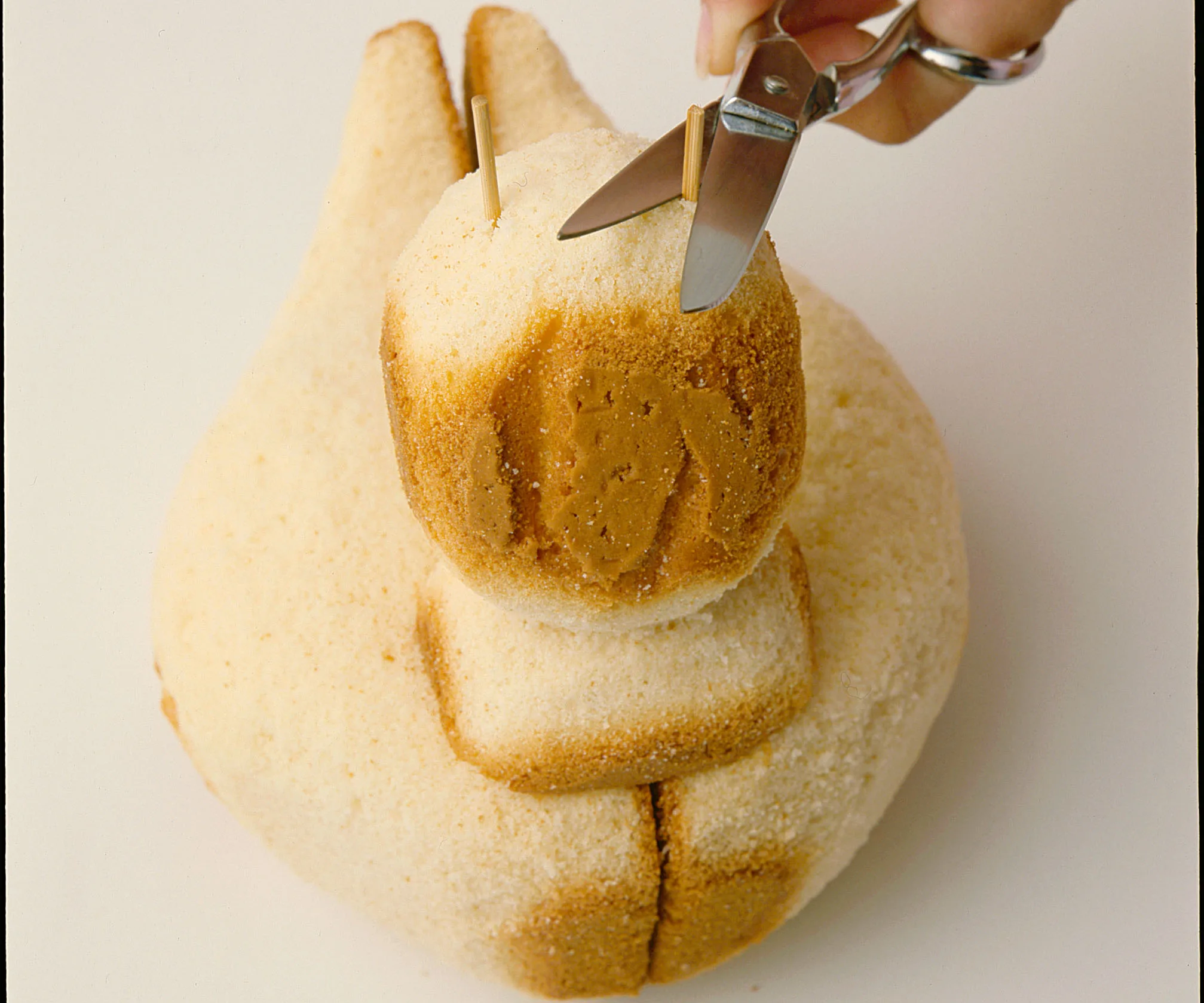
Shape duck’s body by making a cut at tail end: cut down on an angle for about 2.5cm (1in), then cut upwards, still on an angle, towards front of body; shape body carefully with small serrated knife to give rounded effect. Position head and neck piece, secure with two bamboo skewers, as shown, pushing skewers right through body. Shape head carefully with small serrated knife, so that neck sits neatly on body; cut off ends of skewers, as shown. It is necessary to leave skewers in place to support head.
Place duck on prepared board, tint Fluffy Frosting with apricot food colouring, cover head and body with Fluffy Frosting, leave sides looking fluffy to represent feathers, smooth head, neck and chest with a small spatula. Small coloured sweets represent eyes and buttons; surround eyes with thin strips of licorice. Yellow popcorn represents down on head, two large potato crisps represent bill. Place large bow at duck’s neck.
Fluffy frosting is made with egg whites, caster sugar and water, and can be tinted any colour. It’s great for decorating and is used in many of our other famous birthday cakes.
Test Kitchen tip
How to make the Duck Cake (video)
Agnes Lee, the creator of the Duck Cake, makes the cake from start to finish. Follow along as she shares her tips plus the story behind the cake’s bow and button decorations.
How to make the Duck Cake: step-by-step assembly
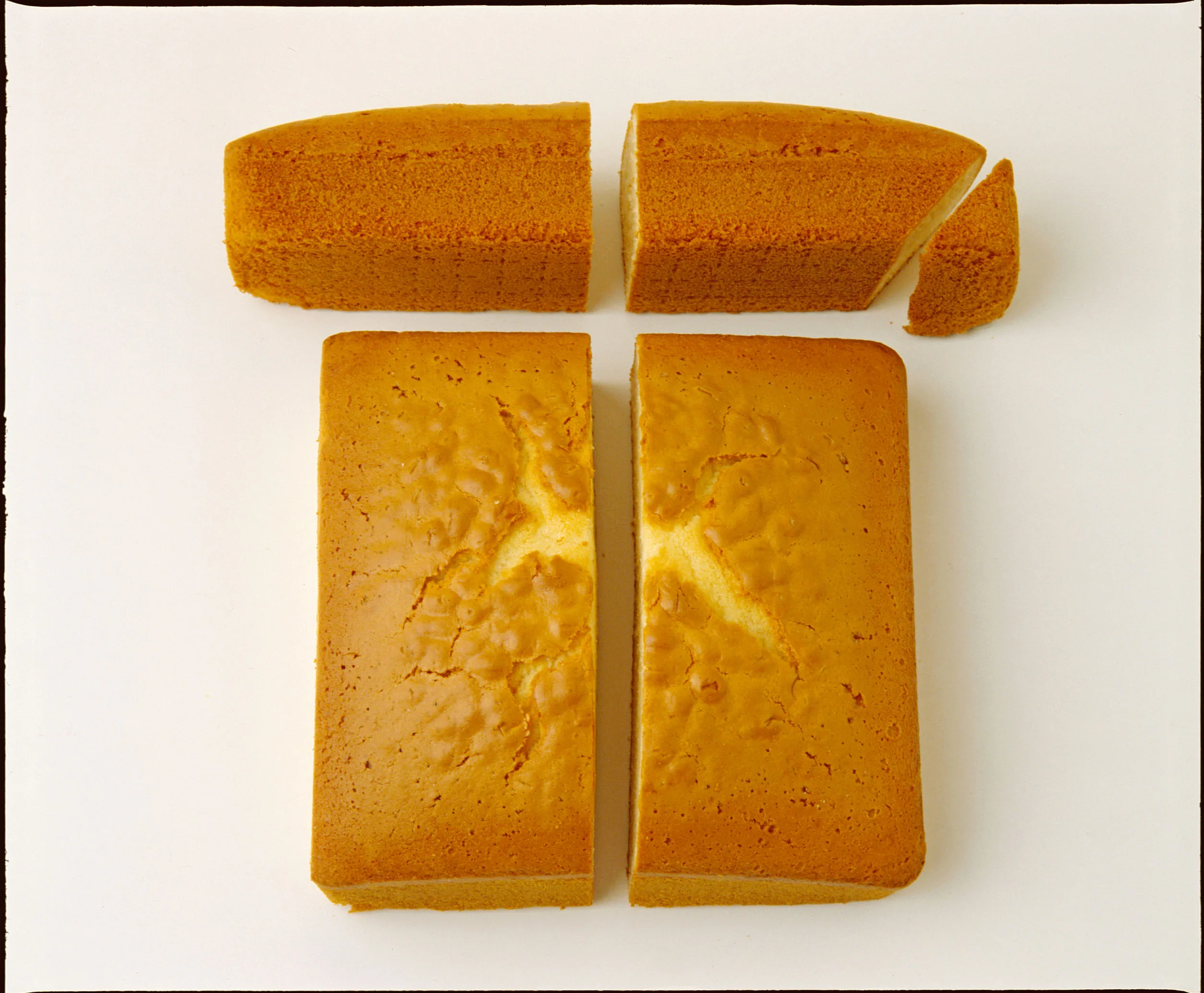
Making The Australian Women’s Weekly Duck Cake starts by cutting a square cake in half vertically (or lengthways), with a bar cake on its side, cut in half with a wedge cut off one end.
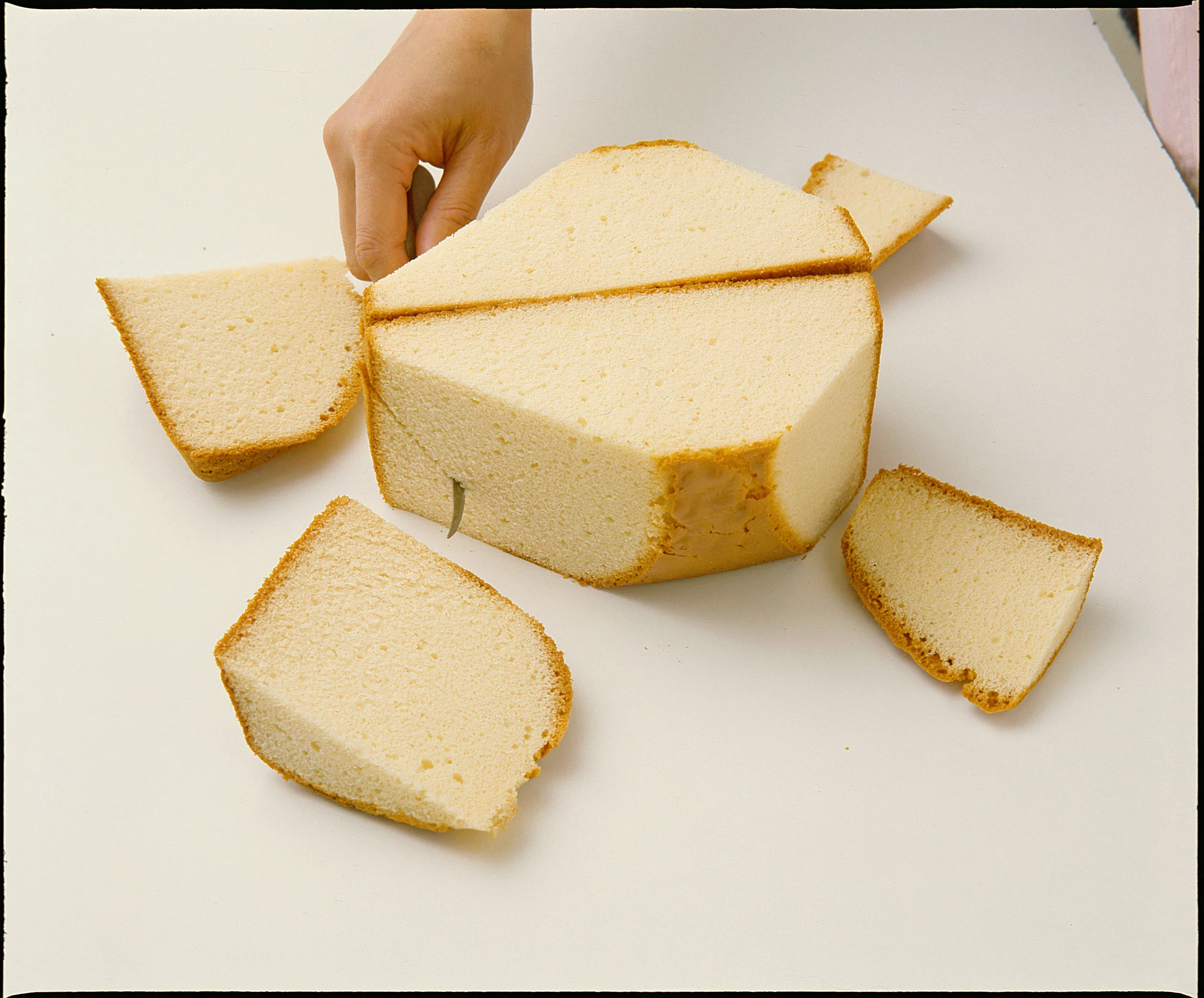
Stand the two pieces of square cake side by side with cut sides up and bases together, cut off the four corners, cutting more from one end than the other, as shown, for the duck’s tail end, then cut a wedge-shaped piece from tail end, as shown, to give shape to the body; discard scraps.
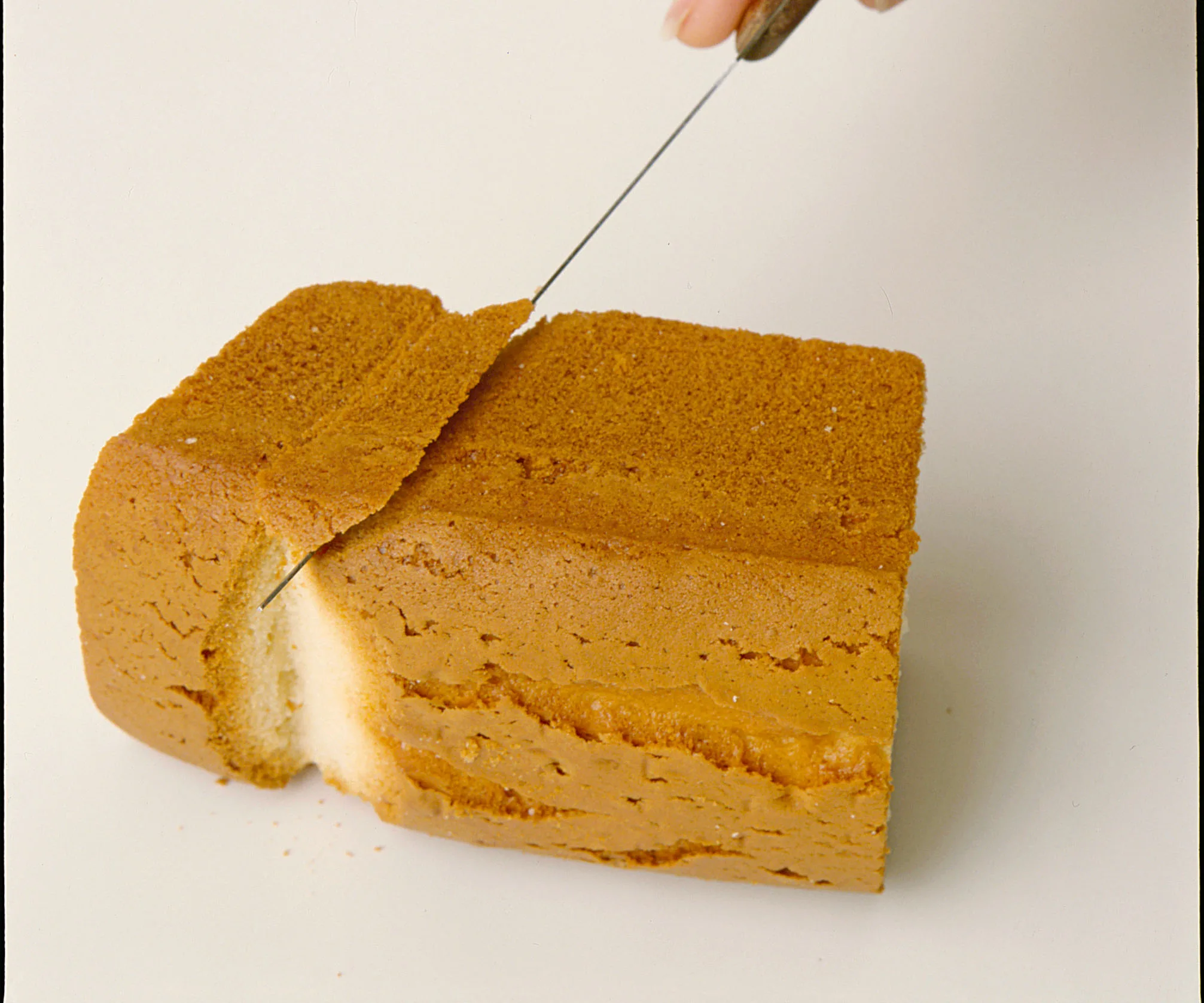
Take the piece of bar cake for head and neck, cut four small wedges, one from each side, 2cm (¾in) in from end where wedge was cut; this angled end is where neck joins body.
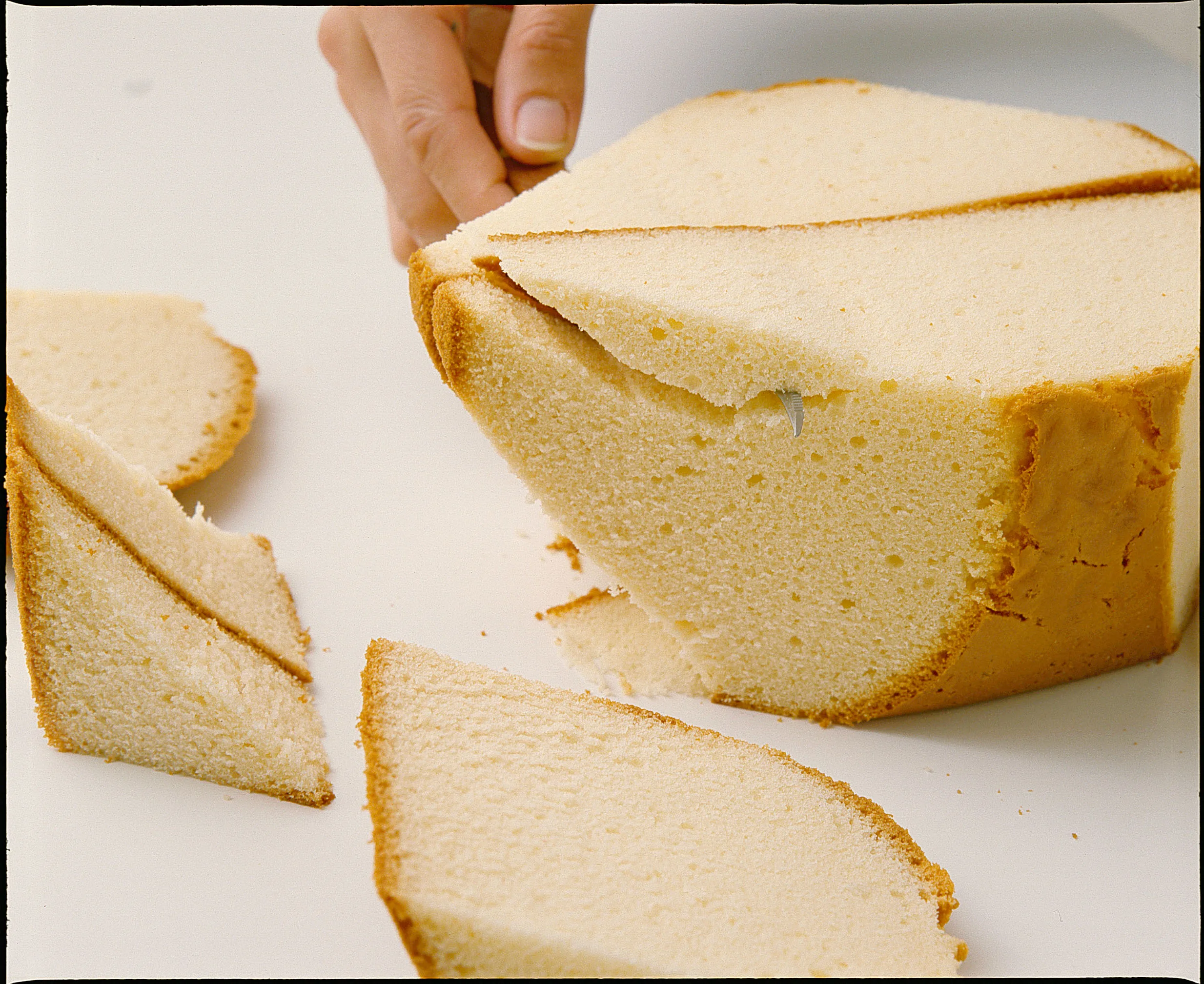
Shape duck’s body by making a cut at tail end: cut down on an angle for about 2.5cm (1in), then cut upwards, still on an angle, towards front of body; shape body carefully with small serrated knife to give rounded effect.
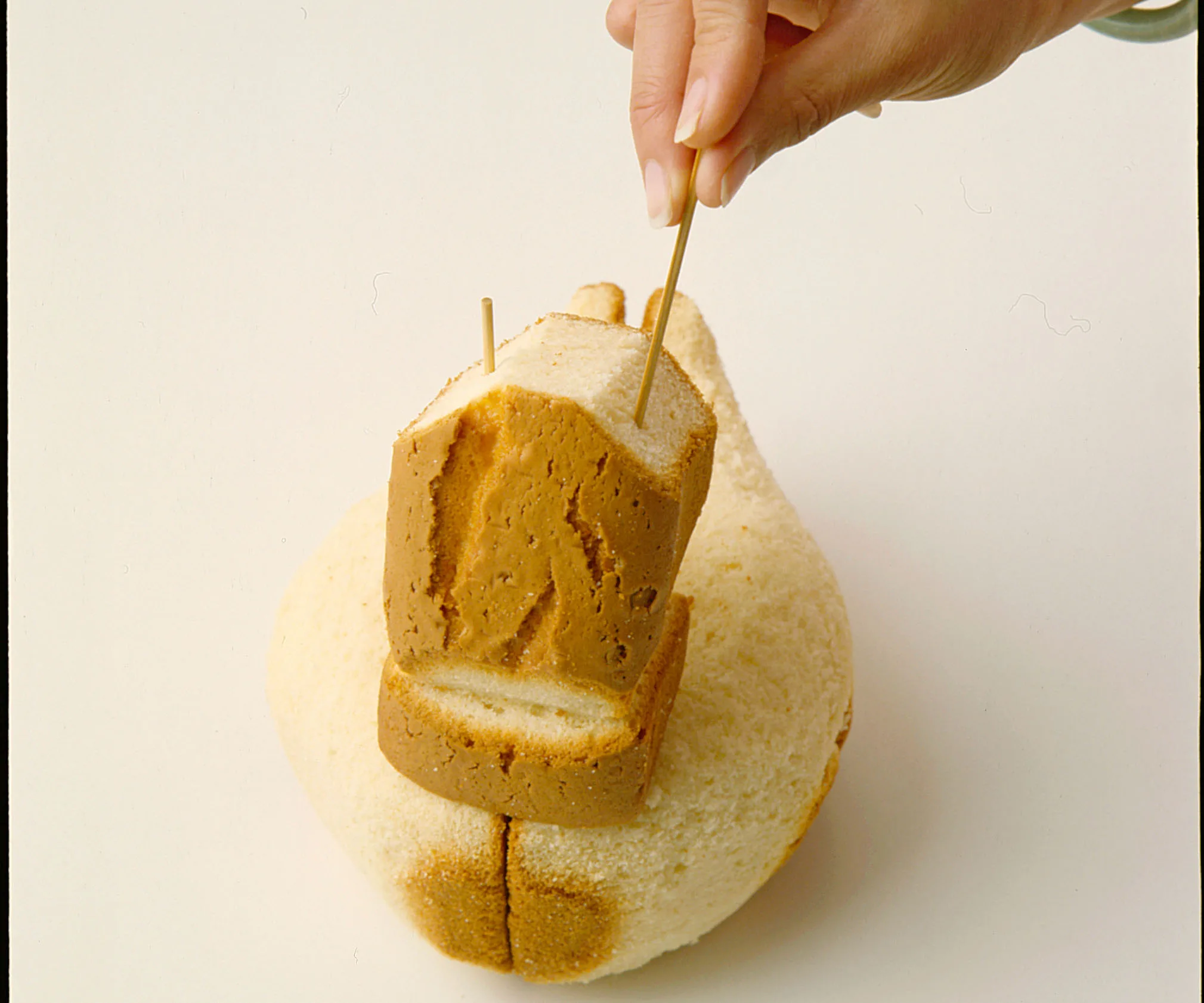
Position head and neck piece, secure with two bamboo skewers, as shown, pushing skewers right through body.
The history of The Australian Women’s Weekly Duck Cake
The Australian Women’s Weekly Deputy Editor Tiffany Dunk talks to original Test Kitchen staffer Agnes Lee about how the Rubber Ducky Cake came together.
They called her Engineer Agnes thanks to her ability to make the trickiest cakes. So it’s no surprise that Agnes Lee was the Test Kitchen employee charged with making the Rubber Ducky. It was the last cake to be made for the book and, as we now know, would go on to be arguably the most famous.
The Weekly’s Food Director Ellen Sinclair had been struck with inspiration whilst giving her grandson Jeremy a bath. Pulling his rubber ducky out of her handbag, she said, “this is the last cake” and Agnes got to work.
“I used two packets of cake mix and a square tin,” she says of getting started. Constructing the body and head and carefully using anything cut off the cakes to make the neck and tail. Using a skewer (“make sure it goes in at an angle,” she warns prospective bakers) to secure the head, neck and body together, she then got working on the butter cream frosting for a fluffy finish.
Next, she looked in the pantry for what else she might need. “I saw the packet of popcorn and put that on the head for a lovely topping. Then I thought, ‘How can I use cake to make the beak and it doesn’t fall off?’ I just gave up and went out for lunch.”
Walking down the street, she passed a milk bar displaying packets of chips. “That can be beak,” she declared.
Adding the liquorice straps and Smarties for eyes, she then put a small red ribbon bow around the neck and presented the finished cake for photography. After staff photographer Russell Brooks gave her the thumbs up that he was happy, she tipped the cake into the bin.
“But after 15 minutes he came back and said, ‘We have to reshoot,’” Agnes says. “I said, ‘Oh no, I’m going to have to make it again’. And then I went, “no, bugger it, I’m going to dig it out of the bin.’”
As the icing had dried, the cake unfortunately now had a crack down the breast which, if you look closely, you can still see in the original version of the book. “I didn’t’ have much icing left so I tried to patch it,” Agnes says. “I used Smarties to hide it but that’s why the bow is now so big!”